

Pablo Serrano - Bread: unity, love and solidarity
A symbol of unity, love, and solidarity, bread is a fundamental element in the work of Pablo Serrano . Considered one of the most important sculptors in history, bread became a recurring theme in the work of the Aragonese artist, representing the need to share, to unite with other human beings, and to find communion through this staple food.
In the series "The Loaves," completed in 1978, Serrano explored the idea of bread as a symbol of understanding and unity. He believed that the world had developed thanks to shared bread and emphasized the importance of the farmer and the baker as the world's first sculptors. However, he also expressed his doubts about human nature, suggesting that nothing is possible if humankind cannot find its own silence and open the doors of communication that give rise to creation.

Bread became the starting point for one of his last series, titled "Bread Broken and Shared," completed in 1983, three years before his death. By then, the Aragonese artist had already been inducted into the Royal Academy of Fine Arts of San Fernando in Madrid and received its Gold Medal. This series is considered a continuation of his earlier works, such as the "Yoke-Units," where abstract forms fit together like puzzle pieces, symbolizing the need to give and receive love. These pieces represent the idea of bread as a food that unites humanity, acting as a symbol and a means of understanding between people. As he himself expressed:
"Bread broken and shared means everything I was looking for; it simplifies communication and signifies inner reflection, self-knowledge, and work."
All of these series, which focused on bread as their central theme, were created on paper, a medium that Pablo Serrano embraced, always closely linked to sculpture and in which he addressed similar issues. Within his graphic work, we can find a wide range of drawings and prints, from preliminary sketches for his sculptures to collages with texts where he concentrated his profound philosophical and conceptual analysis, as well as serigraphs where he used visual language to express his ideas in a way that differed from his sculptures.
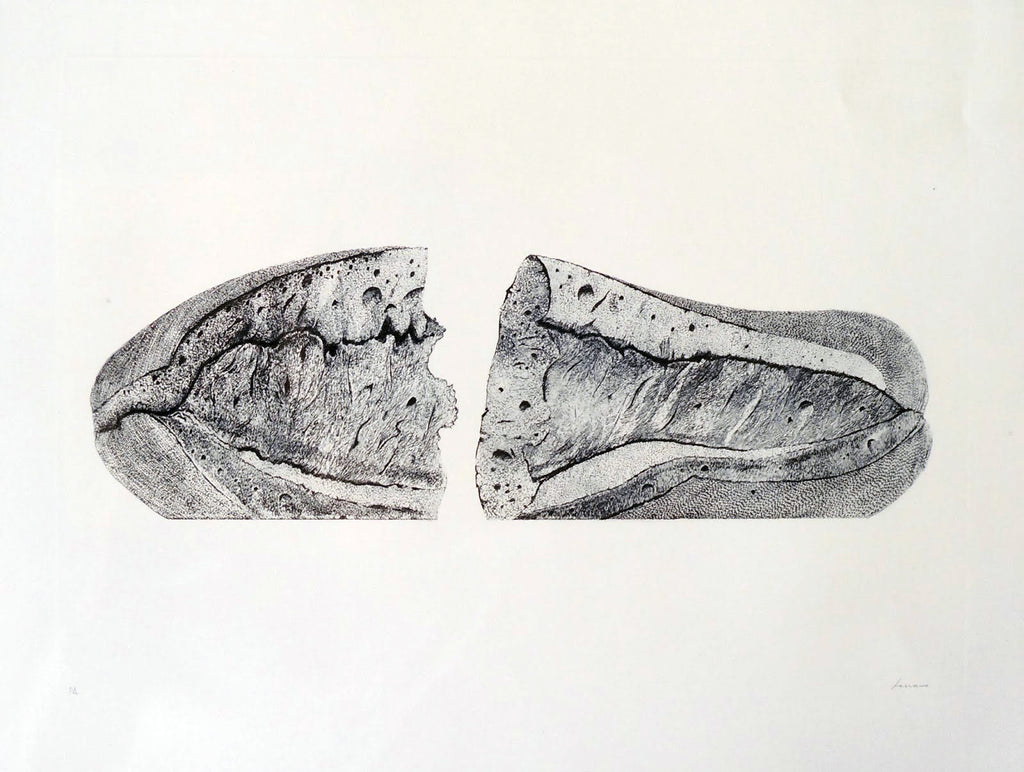
'Loaf of Bread' - Artwork exhibited at the Hermitage Museum in St. Petersburg
An example of this is the series of prints he created based on the aforementioned concepts of "Unit-Yoke" and "Shared Bread," where the forms differ completely from his sculptures, but maintain the idea of two parts that fit together. Through drawing and printmaking, Pablo Serrano was able to express himself more freely and incorporate the use of color so that bread would culminate in a humanism evident throughout his work, as a testament to the capacity to give to others.
A universal artist
Born in Crivillén, Teruel, in 1908 and died in Madrid in 1985, Pablo Serrano spent 25 years of his life between Argentina and Uruguay. He was a co-founder of the El Paso Group , along with Saura, Viola, Millares, and Canogar, among others. He was a finalist at the Venice Biennale in 1962, finishing behind Giacometti, and received the Prince of Asturias Award for the Arts in 1982. He is the only Spanish artist, along with Picasso, to have had a solo exhibition at the Hermitage Museum in Saint Petersburg during his lifetime. His work is held in prominent museums worldwide, such as the MoMA and the Guggenheim in New York, the Pompidou Centre in Paris, the Vatican Museums, and the Reina Sofía Museum.
Serrano donated a significant part of his legacy to Aragon, giving rise to the Pablo Serrano Museum in Zaragoza.


