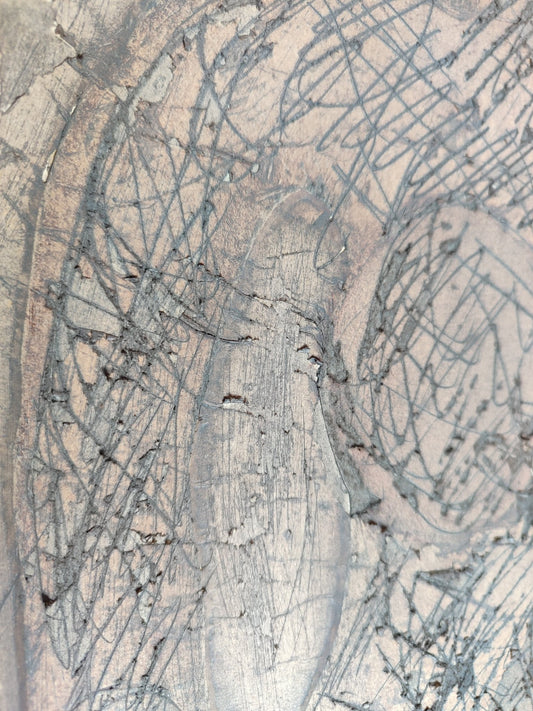
Collection: Agustín Alamán ┃ Abstract Work

Agustín Alamán (Tabernas de Isuela, Huesca, 1921 – Madrid, 1995) was a Spanish painter whose work falls within the abstraction and informalism movements of the 20th century. His canvases are notable for their experimentation with materials such as plaster, sand, marble dust, and wood, creating compositions rich in texture, color, and expressive power. After establishing his career in Uruguay and Latin America, Alamán returned to Spain, leaving a legacy that combines innovation, plastic force, and modernity.

Add a work by Alamán to your collection and connect with his art, full of history and expression.

Agustín Alamán ┃ Obra Abstracta - Gaudifond

Collapsible content

Biography

Huesca, 1921 – Madrid, 1995. Agustín Alamán emigrated to France in 1939, before the end of the Spanish Civil War, and endured terrible years in concentration camps. Settling in Alés, Alamán began painting on his own. In 1948, he joined the Art Cévenol art society and participated in several group exhibitions in the
mentioned institution, and in another of Spanish refugee painters in Toulouse, with the participation of Picasso, until 1954.

Alamán then began his exploration of abstraction in 1954 and settled in Montevideo, Uruguay, in 1955. There he held his first solo exhibition at the Alfa Bookstore of publisher Benito Milla. These were small-format paintings within the abstract style, where fluid materials and intentional graphic elements foreshadowed an erratic, romantic expressionist spirit.

A visit to an exhibition of Victor Vasarely, the master of kinetic art, in 1958, brought about a substantial shift in Alamán's work. He successfully assimilated the geometric canon, achieving a refined technique in what can be considered a fruitful period, marked by personal discoveries on par with those of the Uruguayan artists José P. Costigliolo, María Freire, and Antonio Llorens, pioneers of that movement.

In the seventies, Agustín Alamán created the Hiroshima series to portray the victims of the atomic bombings of that city with a primitive force similar to prehistoric art.

AWARDS

1961. First prize “Arcobaleno” Punta del Este (Uruguay,
1964. Second prize at the American Biennial of Art. Córdoba, Argentina

MUSEUM WORKS


National Museum of Fine Arts, Madrid

Museum of the Americas, Madrid

Juan Manuel Blanes Museum of Montevideo

Contemporary Museum of Chile

Museum of Fine Arts of Caracas

Museum of Fine Arts of Buenos Aires

Säo Paulo Museum of Modern Art

Museum of Modern Art of Rio de Janeiro

Malcolm-Forbes Collection, New York

South American Art Collection, University of Texas, USA.

Kaiser Industries Collection, Córdoba, Argentina


SELECTED EXHIBITIONS


Of Agustín Alamán's more than one hundred exhibitions, the following stand out:


1963. General Electric Institute

1964. Uruguayan Painters. Divulgaçao Gallery, Lisbon

Museum of Modern Art of Buenos Aires

1965. South American Gallery, New York

1966. Lambert Gallery. Buenos Aires, Argentina

Retrospective exhibition. National Fine Arts Salon, Montevideo, Uruguay

1968. Lima Biennial. Peru

Cali Biennial, Colombia

1969.VII Säo Paulo Biennial, Brazil

University Gallery, Montevideo, Uruguay

1971. Grosvenor Gallery, Madrid

1972. Gaudí Hall, Barcelona

Varrón Gallery, Salamanca

15th Century House, Segovia

Exhibition of Masters of Spanish Painting
1974. International Biennial of Serian Art

1977. Varrón Gallery, Salamanca

1979. Varrón Gallery, Salamanca

Gastón Room, Zaragoza

1981. Diart, Madrid

1982-1986. Madrid International Contemporary Art Fair

2019. Huesca Casino