Eduard Alcoy (Barcelona, 1930 - Mataró, 1987) belonged to an intermediate generation of artists who, during the post-war period, were influenced by Tàpies and informalism, and who found themselves in the middle of the avant-garde promotions.
Alcoy founded, in 1957, together with Hernández Pijuán , Rovira-Brull and Carles Planell, the Sílex Group . In 1959, together with Subirachs , he founded the Barcelona School. Alcoy worked in advertising and as a graphic designer, which introduced him to meticulousness and detailed work, until, in 1970, he devoted himself exclusively to painting. This was a period of contact with Italian art dealers and gallery owners, frequent trips to Turin, and the expansion of his artistic field: new graphic works, his first jewelry pieces, sculptures, and pyrography.
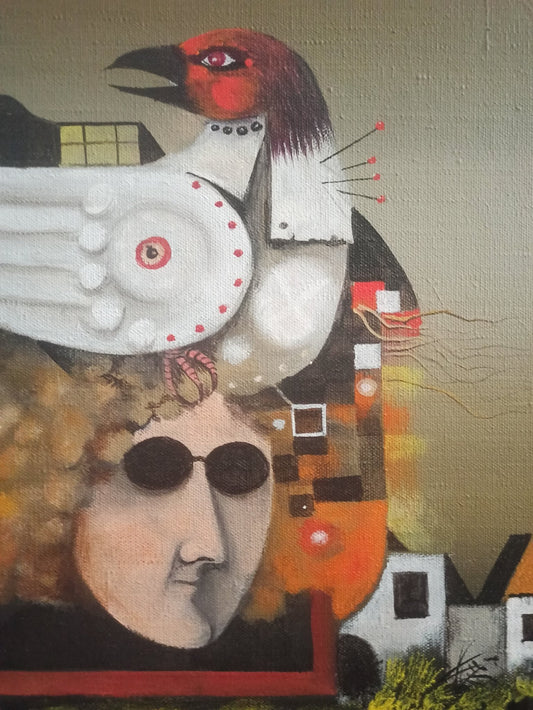
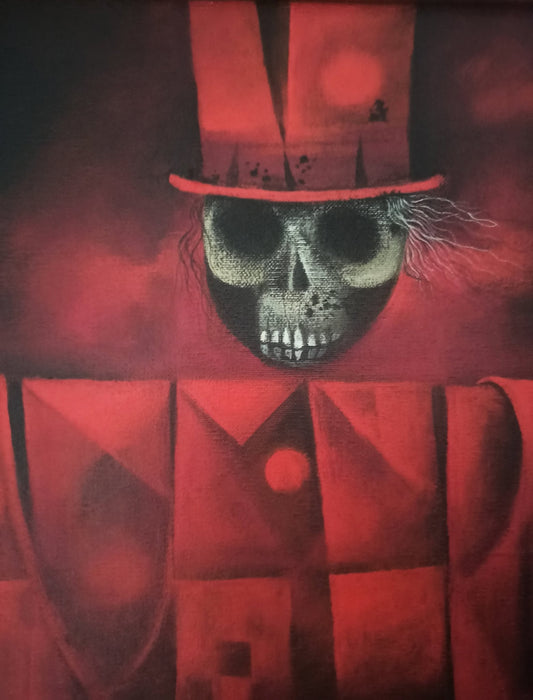
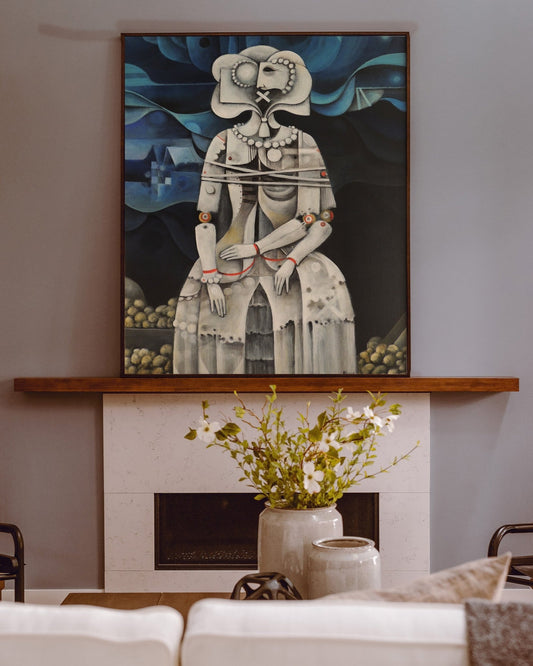
Constructivist and cubist in his conception of forms, Eduard Alcoy carried out a volumetric study of surfaces through physically oriented environments
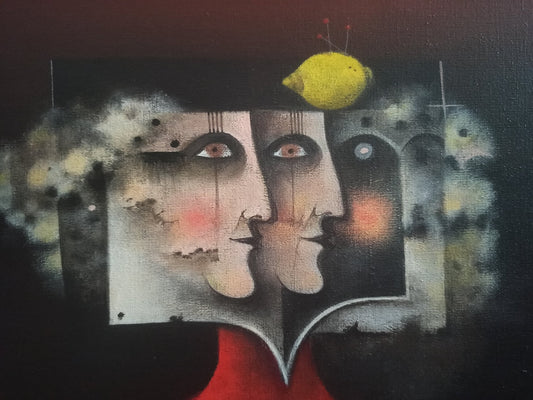
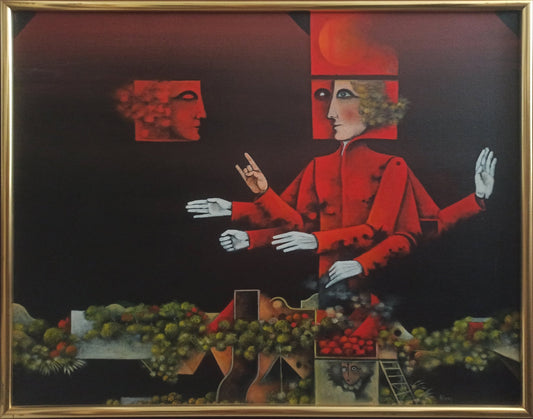
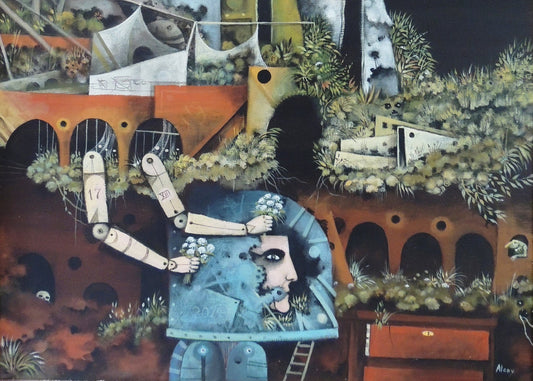
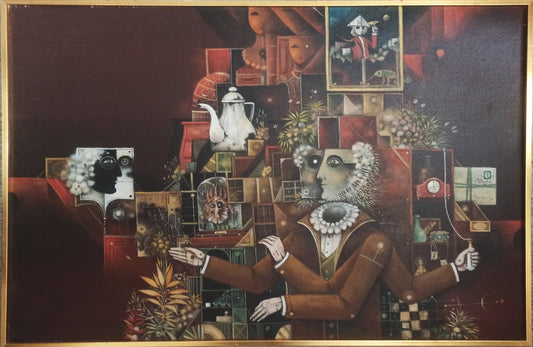
Impossible, utopian, or absurd, with a multitude of contrasts presented in an anarchic manner. Alcoy's works recall the magical vertigo of Bosch, but always with a bitterly sarcastic and poetically emotive undertone. His vast worlds are replete with meticulous details and symbols hidden in the most unexpected and improbable places: staircases that emerge from nowhere and lead to nothingness, demons with articulated arms, half-faces without foreheads, clocks, numbers, animals, balconies, thickets, Ku Klux Klan figures, Don Quixotes, madmen, frames, fish, hats, ravens, bullfighters, cross-eyed women, monocles, and, suddenly, an enormous void.
THE CRAFT OF LIVING, THE CRAFT OF PAINTING: By Manuel Vázquez Montalbán
Eduardo Alcoy began painting in the 1940s and started exhibiting in 1950. His name then appeared alongside those of the pioneers of Informalism. It was the aesthetic battle of those years, a double aesthetic battle in our country because, in a way, the established official truths reached the codes of painting and continued to exert a certain Goebbelsian influence applied to the “art of decadent artists.” Informal painting, with all its variations and levels of informality, had a historical significance as a struggle for aesthetic truth, almost always traversing the vicinity of historical truth.
Alcoy persisted in that endeavor until his livelihood no longer aligned with his art. The painter could no longer live off his painting and applied his visual talent to advertising, putting colors and forms at the service of consumer persuasion, in a novel and futuristic formula of “applied arts.” But in that double life that the vast majority of Hispanic artists must accept, in the solitude of his leisure, Alcoy's painting persisted in its logic. The stains, crusts, and pre-forms that had characterized his first stage were gradually ordered and gave way to a new symbolic formalism. By one of those cinematic coincidences—one could speak of a pictorial spaghetti—some paintings produced in Alcoy's “other life” as an advertiser reached a discerning Italian art connoisseur. From that moment on, Alcoy had what few painters have: a fixed, secure clientele and the possibility of storing in the attic of memory the times when the profession of living did not coincide with the profession of painting.
Alcoy has created a cosmic and human geometry that inherits the discoveries of all figurative painting from Bosch to Cubism, but within a most peculiar atmosphere, as if the painter's contribution were fundamentally the ideal environment for his creatures to live in. Sometimes Alcoy's world and characters seem to survive great destruction. Sometimes they simply play within the rectangular field that the God-Painter has granted them to compose the gesture. The logical relationship between what Alcoy subconsciously or consciously wants to say and what the viewer perceives belongs to the randomness of interpretation and transforms that interpretation into a creative adventure that every artist offers to their audience. The forms and figures multiply in the space of the painting as if they feared the brevity of the time allotted to them to live or as if they were emerging from a long imaginative confinement.
Perhaps therein lies the key to Eduard Alcoy's painting. His figures escape the long imaginative confinement that the act of living imposed on the act of painting.
SOLO EXHIBITIONS
2018. Museu de Mataró, Barcelona, Spain
2017. Llavaneres Museum, Barcelona, Spain
1986. Escola L'Aixernador. Argentina, Spain
1985. Gothic Room of the Institute of Lleredenc Studies. Lleida, Spain
Gaudí Room - Gaudifond Art Barcelona, Spain
Palamós-Center, Palamós, Spain
1983. Dilil la Joielli d'arte. Turin, Italy
1982. Sant Jordi Gallery. Girona, Spain
Sant Lluc Gallery. Olot, Spain
El Colom Gallery. Cadaqués, Spain
1981. Gaudí Room - Gaudifond Art. Barcelona, Spain
Palamós-Center. Palamós, Spain
1980. “Anthology Eduard Alcoy (1947-1980)”. Municipal Museum of Mataró, Spain
1978. Davico Gallery. Turin, Italy
Gaudí-Gaudifond Art Gallery Barcelona, Spain
Cop d'Ull Art Room. Lleida, Spain
Gaston Room. Zaragoza, Spain
1977. Kandinsky Gallery. Center for the Dissemination of Art. Madrid, Spain
Crida Gallery. Alcoy, Spain
Tertre Gallery. Mataró, Spain
Gallery 11. Alicante, Spain
1976. Lucas Gallery. Gandía, Spain
Gaudí Room - Gaudifond Art. Barcelona, Spain
Alcoiarts Gallery. Altea
Atica Gallery. Buenos Aires, Argentina
University Gallery, Montevideo, Uruguay
1975. Uranga Gallery. Bilbao, Spain
Set i Mig Gallery. Alicante, Spain
Solana Museum. Queveda. Santander, Spain
1974. Berdusan Gallery. Zaragoza, Spain
Gaudí Room - Gaudifond Art. Barcelona, Spain
Luis' Gallery. Madrid, Spain
1973. Galleria di Villa Ricco. Levanto, Italy
Punto Gallery. Valencia, Spain
Cap Gros Bookstore and Room. Mataró, Spain
1972. Gaudí Room - Gaudifond Art. Barcelona, Spain
1971. Davico Gallery. Turin, Italy1969. Articolor Room. Vich, Spain
Galería d'Art P. Tarragona, Spain
1968. Mataró, Spain
Aixela Room. Barcelona, Spain
1966. “Alcoy. Paintings” Mataró, Spain
1958. Hernández Monpó Gallery. Valencia, Spain
1957. Fernando Fe Gallery. Madrid, Spain
1955. Mataró Municipal Museum. Spain
GROUP EXHIBITIONS
1986. Círculo de Bellas Artes, Madrid, Spain
1981. Homage to Picasso. Chapel of the former Hospital de la Santa Creu. Barcelona, Spain
1979. Die Internationale Kunstmesse. Basel
“Catalan Artists”. Rafael Monasterios Gallery. Maracay, Venezuela
“5 Aspects of Contemporary Surrealism.” Rua Art Gallery. Santander, Spain
1978. Homage to Joan Miró. Palau de Sollerich. Mallorca, Spain
Tribute to Lola Anglada. Tiana People's House. Barcelona, Spain
“Art and International Humanism for Equatorial Guinea”.
Tertre Gallery. Mataró, Spain
Basel International Art Fair, Switzerland
1977. Lucas Gallery. Gandía, Spain
1975. Exhibition 75. Gaudí Hall - Gaudifond Arte. Barcelona, Spain
“Plantastischer realismus in Spainen” Palais Palffy. Vienna, Austria
1974. VII International Biennial of Prints. Krakow, Poland
“Art Espagnol d'Aujourd'hui”. Musées Royaux des Beaux Arts. Brussels, Belgium
1st International Biennial of Graphic Works and Serial Art. Segovia, Spain
“Spanish Kunst Heute”. Haus der Kunst. Munich, Germany
“Heart Landscapes” Amsterdam, Netherlands
1973. Piccola Gallery. Santa Margherita Ligure, Italy
“From the Barcelona School” Gaudí Room - Gaudifond Arte. Barcelona, Spain
1972. Bolaffi Room. Turin, Italy
1971. “Current Catalan Art” Adria Gallery. Barcelona, Spain
Schreiber Gallery. Brescia, Italy
International Graphic Exhibition. Aosta, Italy
1970. Artesport 70. Bilbao, Spain
1969. Círculo 2 Gallery. Madrid, Spain
1968. First Biennial of Painting. Bilbao, Spain
1962. “Contemporary Spanish Painting and Sculpture” Marlborough Gallery,
London 1961. “Contrasts in contemporary Spanish painting” National Museum
Museum of Modern Art, Tokyo.
National Museum of Modern Art Nagoya, San Francisco, International House Denver and New York
1960. “Contemporary Spanish Art” Aschaffenbourg, Germany
1st Jazz Festival. Granollers, Spain
Space and color in contemporary Spanish painting. Museum of
Modern Art. Sao Paulo and Montevideo, Uruguay
XXX Valencia Biennial. Spain
“Before Picasso, After Miró” Guggenheim Museum. New York, USA.
Gaspar Room. Barcelona, Spain
Prisma Gallery. Madrid, Spain
Contemporary Spanish art. Vienna, Austria
Contemporary Spanish art. Berlin, Germany
“Alcoy, Hernández Pijuan” Frankfurt am Main, Germany, Almada, Portugal
“Catalan current painting” Foz Restauradores Palace. Lisbon, Portugal
“Contemporary Catalan Painting” Alvarez Gallery. Porto, Portugal
Zero Figure. Informal homage to Velázquez. Gaspar Room. Barcelona, Spain
“Current Spanish art” Copenhagen, Denmark
Museum of Contemporary Art. Barcelona, Spain
1959. “Twenty Years of Spanish Painting” Lisbon and Porto, Portugal
III May Salon. Barcelona, Spain
III Alexandria Biennial. Valencia, Spain
Contemporary Mediterranean Art. Number Gallery. Florence, Italy
Huemul Gallery. Buenos Aires, Argentina
Space and color in contemporary Spanish painting. Museum of Modern Art. Rio de Janeiro, Brazil
“From the Barcelona School” Biosca Gallery. Madrid, Spain
1958. II Mediterranean Biennial. Alexandria, Colombia
II May Salon. Barcelona, Spain
1957. Jazz Hall. Barcelona, Spain
Silex Group. Syra Gallery. Barcelona, Spain
X October Salon. Museum of Modern Art. Barcelona, Spain
First May Salon. Barcelona, Spain
1956. Silex Group. Alicante and Cartagena, Spain
9th October Salon. Barcelona, Spain
II Magazine Salon. Spain
1955. III Hispano-American Art Biennial. Barcelona, Spain
1954. Inter-Nos. Garden Gallery. Barcelona, Spain
1953. Inter-Nos. Granollers Museum. Barcelona, Spain
1950. 4 Painters. Pino Room. Barcelona, Spain
WORKS IN MUSEUMS
Museum of Contemporary Art. Madrid, Spain
Museum of Contemporary Art. Barcelona, Spain
National Art Museum of the People's Republic of China
Granollers Museum. Spain
Boschi. Milan, Italy
Kurz of Wolframs-Echenbach. Germany
Ströher am Main. Germany
Pope Graziano. Lugano, Switzerland
John Updike Ipswich. Massasuchets, USA
Propper. Oslo, Norway
Wagner Mainz, Germany